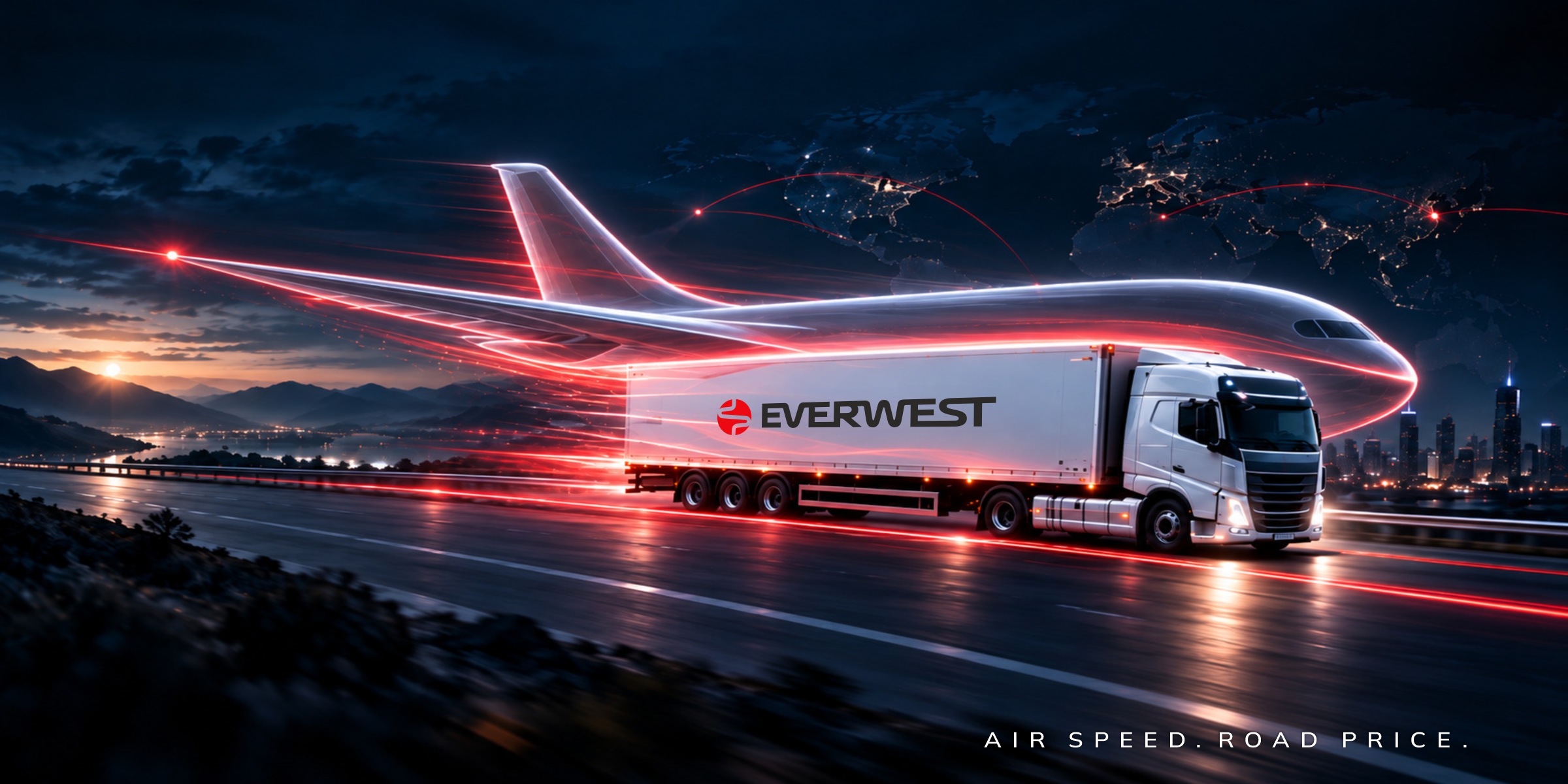
With delivery times of 11–17 days, road freight is emerging as a practical alternative for businesses that need faster deliveries from Asia without paying the full premium for air transport.
Cargo can now travel from China to Europe by road in as little as 11 days, at up to 70% lower transportation cost than air freight, according to Everwest, a logistics company specializing in transportation between Asia and Europe. The company estimates that road transportation can generate up to 10 times fewer CO₂ emissions than air freight, offering businesses another way to balance speed, cost, and environmental impact.
For European importers used to choosing between fast but expensive air freight and more economical but slower sea transport, road freight offers an increasingly relevant third option. While air freight typically takes 5–12 days door-to-door and sea freight can require 30–45 days, road transportation from China and Southeast Asia to Europe can take approximately 11–17 days, depending on the origin, destination, and route.
This allows companies to reassess how they transport time-sensitive goods, particularly when delivery within two weeks is sufficient to meet production schedules, maintain stock availability, or fulfil customer commitments.
A third option between air and sea
Traditionally, businesses importing goods from Asia have faced a simple trade-off: choose air freight when speed is critical or sea freight when transportation costs are the priority.
However, the development of international road transport corridors, improved shipment visibility, and more integrated door-to-door services are changing that equation.
“Many businesses aren’t buying air freight because they need air freight. They’re buying certainty,” says Zigmas Mikoliūnas, CEO of Everwest.
“When we evaluate actual supply chain requirements, we often find that road transport can deliver the same outcome at a road price, not an air freight price. The real question is not how fast a shipment can move, but how fast it needs to move.”
Road freight is particularly suitable for shipments that cannot wait six or more weeks for sea transport but do not require delivery within a matter of days.
For example, a European retailer replenishing seasonal inventory, an electronics distributor responding to changing demand, or a manufacturer waiting for components may need delivery within 10–15 days rather than within a week. In such cases, the additional speed of air freight may not justify the added cost.
How fast can cargo travel from China to Europe by road?
Recent shipments managed by Everwest Group demonstrate the transit times currently achievable on Asia–Europe road corridors. One recent example involved a fashion customer whose cargo was transported from China to Sweden in just 11 days.

According to Everwest, indicative road transit times from China to key European markets include:

Actual delivery times depend on the shipment’s origin, destination, border crossings, customs procedures, and operating conditions.
“Our transit times refer to the complete door-to-door journey on a specific route, from collection at the supplier’s premises to delivery at the customer’s address. For example, this means pickup from a factory in Shanghai and final delivery to a warehouse in Sweden, including the customs clearance stage and the last mile,” says Tomas Kuchumov, Business Unit Manager at Everwest. “ For many businesses, these transit times are sufficient to meet customer commitments, maintain inventory levels, and support production schedules without paying the premium associated with air freight.”
Kuchumov explains that the difference between air and road transportation becomes more relevant when companies compare the complete door-to-door journey rather than only the time spent in transit.
“Air freight is undoubtedly faster. But cargo does not move from one airport to another without additional handling and processing. Collection, airport processing, customs clearance, and final delivery all contribute to the total transit time. When businesses evaluate the full journey, the difference between air and road can be smaller than expected.”

Why the cheapest or fastest transport mode is not always the best choice
Transportation decisions are about more than choosing the lowest freight rate or the shortest delivery time.
For businesses importing goods from Asia, the right transport mode depends on several factors: how urgently the cargo is needed, the value of the goods, inventory availability, storage costs, and the consequences of delayed delivery.
Air freight remains essential when every day matters. However, using it automatically for shipments that can tolerate longer transit times may result in unnecessary transportation spending.
Sea freight generally offers a more economical solution for planned, high-volume shipments, but longer transit times require businesses to forecast demand further in advance and maintain sufficient inventory.
Road freight can fill the gap between these two options.
For example, a shipment that would otherwise travel by air could potentially be delivered by road within two weeks. If that timing still meets the business requirement, the company may significantly reduce logistics costs without disrupting its operations.
According to Everwest, the cost difference can reach up to 70% compared with air freight, although actual savings depend on cargo characteristics, shipment size, route, and market conditions.
The opportunity is especially relevant for fashion and retail, e-commerce, consumer electronics, smart home devices and robotic appliances, automotive components, and other industries where product availability and delivery timing directly influence commercial performance.
Selected pharmaceutical products, food products, and lithium-ion batteries may also be suitable for road transport, provided that the necessary handling, safety, and regulatory requirements are met.
Lower emissions add another reason to reconsider transport choices
Beyond transportation costs, the environmental impact of freight is becoming an increasingly important factor in supply chain decisions.
Air freight generally has a substantially higher carbon footprint than road transportation, making transport mode selection an important consideration for businesses working to reduce logistics-related emissions.
According to Everwest estimates, road freight on the Asia–Europe corridor can generate approximately 10 times lower CO₂ emissions than air freight.
“Organizations face increasing pressure to reduce supply chain emissions while maintaining service levels,” says Mikoliūnas. “Road transport provides an opportunity to improve the balance between speed, cost efficiency, and sustainability.”
The actual environmental benefit depends on vehicle utilization, route distance, fuel type, and shipment characteristics. Nevertheless, shifting suitable shipments from air to road can offer companies an opportunity to reduce emissions while maintaining delivery schedules.

The future of freight is about choosing the right speed
The growing relevance of road freight does not mean that air or sea transport will become less important. Each mode serves different supply chain requirements.
Air freight remains the preferred choice for exceptionally urgent shipments, highly time-sensitive goods, and cargo where the value of faster delivery outweighs the additional expense.
Sea transport remains important for cost-efficient movement of large volumes, particularly when shipments can be planned well in advance.
Road freight offers an alternative between the two, particularly for businesses that require relatively fast, predictable deliveries but have some flexibility in their transportation schedules.
“Air freight will always play an important role in global supply chains,” says Zigmas Mikoliūnas. “The challenge for decision-makers is determining when additional speed actually creates additional value. If a shipment can move from China to Europe in 11 to 17 days and still meet production schedules, inventory requirements, and customer commitments, the question becomes whether paying substantially more is justified.”
As European businesses continue looking for ways to improve supply chain efficiency, understanding the full range of available transport options is becoming increasingly important.
For many shipments, the choice is no longer simply between fast air freight and economical sea freight. Road transportation is creating a third option: one that delivers much of the speed businesses need without the full cost of air freight.
About Everwest
Everwest is a road logistics company with more than two decades of experience, specializing in transportation between China, Southeast Asia (including Vietnam, Thailand, Cambodia, Bangladesh, and Laos), and Europe. With an own fleet of more than 1,000 vehicles, the company provides road transport, freight forwarding, and door-to-door logistics solutions across international trade corridors.